Kitchen Scale vs Measuring Cups for Baking: Why Weighing Ingredients Changes Everything
Quick Answer: When comparing a kitchen scale vs measuring cups for baking, the scale wins every time. A single cup of flour can vary by 30 to 50 percent depending on how you scoop it — that’s enough to ruin any recipe. A scale gives you the exact same amount every time, which means consistent results every time. It’s a $13 upgrade that fixes the most common cause of baking failures overnight.
This post contains affiliate links. If you buy through them, I may earn a small commission at no extra cost to you — it’s what keeps this site running and lets me keep testing gear so you don’t have to.
The Experiment That Changed How I Bake
Before I explain why a scale matters, I want you to try something. Grab your measuring cup and a bag of flour. Scoop a cup of flour the way you normally would. Dump it on a plate. Now do it again — same cup, same flour, same technique. Do it five times.
If you had a scale, you’d find that each of those five “cups” weighs something different. Maybe the first one is 135 grams. The second is 160. The third is 145. The fourth is 175. The fifth is 128.
That’s not five cups of flour. That’s five different amounts of the most important dry ingredient in your recipe. And every single one of them will produce a slightly different bake — some too dry, some too dense, some too crumbly, and maybe one that’s accidentally perfect.
This is why baking feels inconsistent for so many people. It’s not your technique. It’s not the recipe. It’s that “one cup” means something different every time you scoop it. This is the core of the kitchen scale vs measuring cups debate — and it’s not really a debate at all.
Why Measuring Cups Are So Unreliable
Measuring cups aren’t designed badly — they’re just the wrong tool for precision. Here’s what’s happening every time you measure flour by volume:
Scooping compacts the flour. When you dip a measuring cup into a bag or canister, the cup pushes through the flour and packs it down. A scooped cup of flour can weigh 180 grams or more. The recipe probably assumed 120 to 130 grams.
Humidity changes flour density. On a humid day, flour absorbs moisture from the air and becomes heavier per cup. On a dry day, it’s lighter. The same cup of flour in July weighs more than the same cup in January.
Different flours weigh different amounts per cup. A cup of bread flour weighs more than a cup of cake flour. A cup of whole wheat weighs more than either. If you’re substituting flours and measuring by volume, your ratios are off before you even start mixing.
Every person scoops differently. Your “cup” and my “cup” are not the same. Some people tap the cup to settle the flour. Some shake it. Some level with a knife. Some don’t. Each habit produces a different weight.
A scale eliminates every single one of these variables. 150 grams of flour is 150 grams of flour regardless of how you scooped it, what the humidity is, or which flour you’re using.
The Real-World Difference
Understanding kitchen scale vs measuring cups becomes obvious when you see what happens to a basic vanilla cake recipe when your flour measurement is off:
| Flour Amount | What Happens to Your Cake |
|---|---|
| 30% too little (~170g instead of 240g) | Batter is too thin, cake is fragile and may collapse |
| 15% too little (~205g) | Cake is tender but may be slightly gummy in the center |
| Correct amount (~240g) | Light, fluffy, perfect texture |
| 15% too much (~275g) | Cake is noticeably denser and drier |
| 30% too much (~310g) | Dense, dry, heavy — the “why is my cake a brick?” result |
The difference between a perfect cake and a dense brick is about 70 grams of flour. That’s the difference between a loosely scooped cup and a firmly packed one. It’s that easy to get wrong — and that easy to fix with a scale.
“But Professional Recipes Use Cups”
Some do, and that’s because cup measurements are more familiar to American home bakers. But if you look closely, you’ll notice a trend: the best recipe developers always include gram measurements alongside cups.
King Arthur Baking, Sally’s Baking Addiction, Serious Eats, America’s Test Kitchen — they all provide weights. The cups are there for convenience. The grams are there for accuracy.
When a recipe only gives cups, here are the standard conversions to get you started:
| Ingredient | Cup Measurement | Weight (grams) |
|---|---|---|
| All-purpose flour | 1 cup | 120–130g |
| Bread flour | 1 cup | 130g |
| Cake flour | 1 cup | 115g |
| Granulated sugar | 1 cup | 200g |
| Brown sugar (packed) | 1 cup | 213g |
| Powdered sugar | 1 cup | 120g |
| Butter | 1 cup (2 sticks) | 227g |
| Cocoa powder | 1 cup | 85g |
Save this table or bookmark this page. Once you start converting your favorite recipes to grams, you’ll never go back to guessing with cups.
When Measuring Cups Are Still Useful
A scale doesn’t replace measuring cups entirely. You’ll still want them for:
Liquids. Water, milk, oil, and other liquids are easier to measure in a liquid measuring cup (the glass kind with a spout) than on a scale. A cup of water is always 237 milliliters regardless of how you pour it, so the inconsistency problem doesn’t apply the same way.
Small amounts. Measuring spoons are still the easiest way to handle a teaspoon of baking powder or a half teaspoon of salt. You can weigh these on a scale, but you’d need one accurate to 0.1 grams, which is more precision than most kitchen scales offer.
Recipes without gram measurements. If you’re following Grandma’s handwritten recipe card that says “2 cups flour,” you need a cup. But even then, weigh that cup once, write down the number, and you’ve converted the recipe forever.
The ideal setup is a scale for dry ingredients plus a liquid measuring cup and measuring spoons for everything else.Together they cover every recipe you’ll ever encounter.
What to Look for in a Kitchen Scale
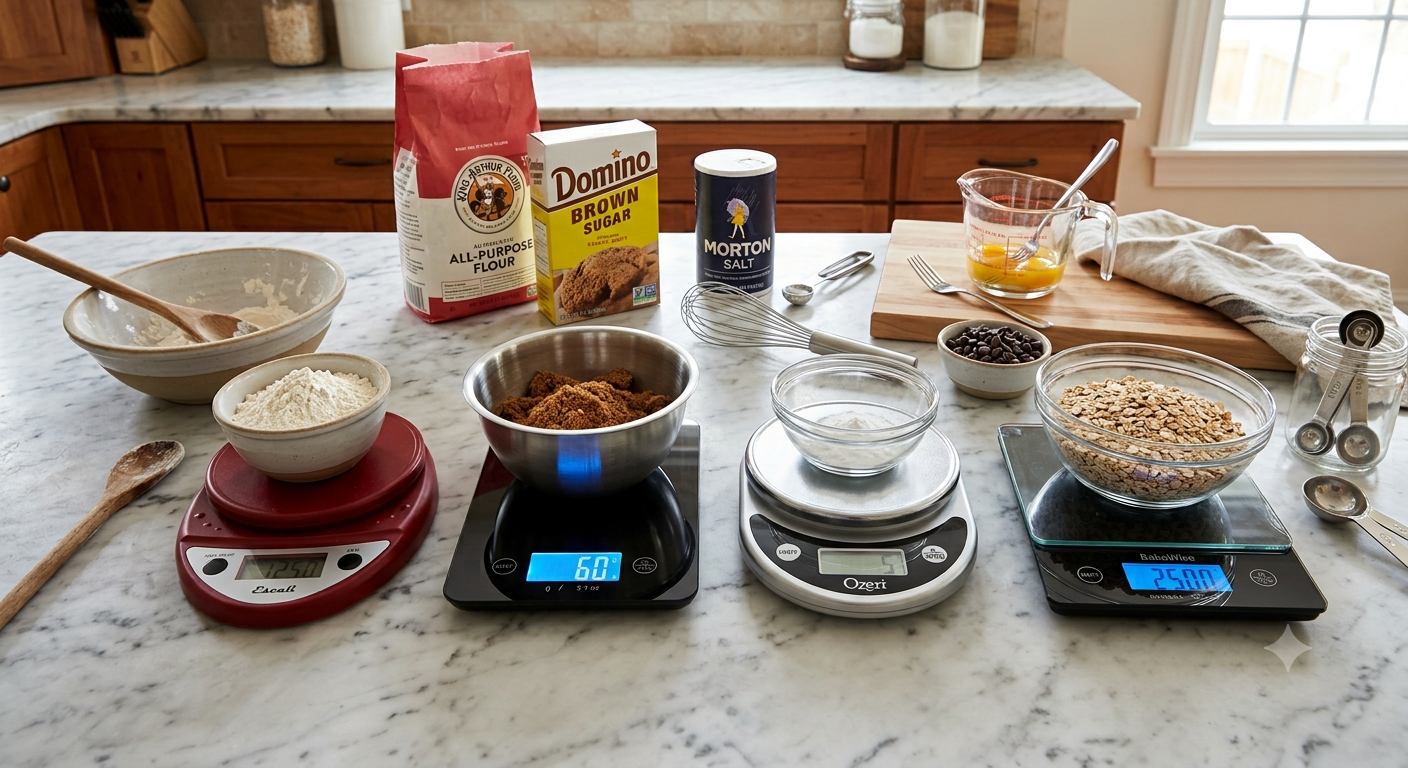
You don’t need an expensive scale. You need one that does four things:
1. Measures in grams. Ounces are fine for cooking, but baking recipes use grams. Make sure it switches between units.
2. Has a tare (zero) function. This lets you place a bowl on the scale, zero it out, and weigh only what you put in the bowl. Essential for adding ingredients one at a time without doing math.
3. Accurate to 1 gram. For most baking, 1-gram accuracy is plenty. You don’t need 0.1-gram precision unless you’re measuring yeast or spices by weight.
4. Has enough capacity. A scale that maxes out at 5 pounds (about 2.2 kg) handles most baking. For large batches or bread baking, look for one that goes up to 11 pounds (5 kg).
Every scale we recommend meets all four criteria. Here are the best options at every price point:
Budget — Etekcity Food Kitchen Scale (~$13)
All you need to start. Accurate to 1 gram, tare function, switches between grams and ounces, and handles up to 11 pounds. The display is clean and the buttons are simple. At $13, there’s no reason not to own one.
Mid-Range — Escali Primo Digital Scale (~$25–30)
Heavier build, faster response, and more durable than the Etekcity. The display is easier to read under large bowls, and the buttons feel more responsive. This is the scale you upgrade to when you’re baking multiple times a week and want something that feels more solid.
Premium — OXO Good Grips Scale with Pull-Out Display (~$55–65)
The pull-out display is the killer feature. When you put a big mixing bowl on the scale, the display slides out so you can still read it. Stainless steel platform wipes clean, and it handles up to 11 pounds. This is the “buy it once, use it forever” option.
For a full comparison of all three, check out our Essential Baking Tools for Beginners guide.
How to Start Using a Scale (It’s Easier Than You Think)
If you’ve never baked by weight before, here’s how to start today:
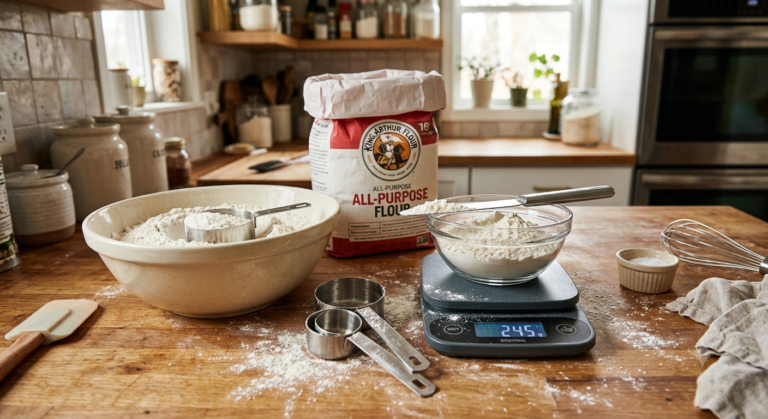
Step 1: Place your mixing bowl on the scale. Press the tare button to zero it out.
Step 2: Add your first dry ingredient (usually flour) until the display reads the correct gram amount.
Step 3: Press tare again to zero the scale with the flour in the bowl.
Step 4: Add your next ingredient (sugar, cocoa, etc.) until it reads the correct amount.
Step 5: Press tare, add the next ingredient. Repeat until all dry ingredients are in the bowl.
That’s it. One bowl, no measuring cups to wash, no flour on the counter, and every ingredient is exactly right. It’s actually faster than using cups once you get used to it.
The Bottom Line: Kitchen Scale vs Measuring Cups
The debate between a kitchen scale vs measuring cups for baking has a clear winner. Cups are fine for cooking soup or making a marinade — close enough is good enough. But baking is chemistry. Small differences in ingredient amounts create big differences in results.
A $13 scale gives you the same precision that professional bakeries rely on. It eliminates the single biggest source of inconsistency in home baking. And it pays for itself within your first few bakes by stopping you from wasting ingredients on failed recipes.
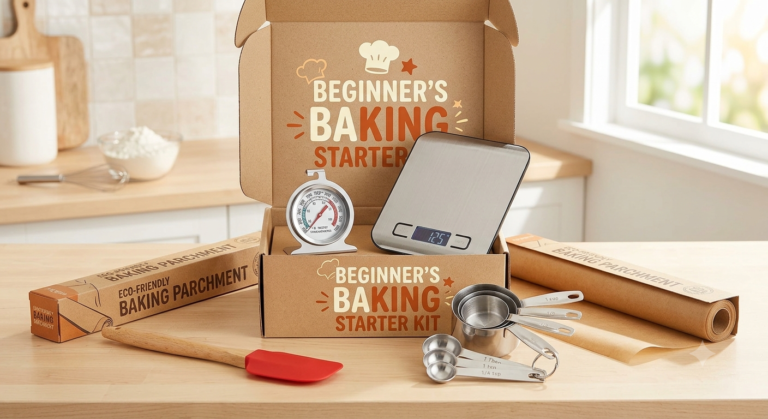
If you’re tired of recipes that work sometimes and fail other times, the scale is your answer. It was the first tool I recommend in our beginner baking kit under $50, and it’s the first tool I’d tell any struggling baker to buy.
Stop measuring. Start weighing. Your bakes will thank you.
Happy baking, Clara Belle
Last updated: [DATE]. Prices fluctuate — always check current Amazon pricing before buying.