Parchment Paper vs Silicone Baking Mat: Which One Should You Use?
Quick Answer: Choosing between parchment paper vs silicone baking mat isn’t an either-or decision — the best setup is having both. Use a silicone mat for everyday cookies and roasting where nonstick convenience and even heat distribution matter most. Use parchment paper for sticky candy, acidic ingredients, recipes where you need to wrap or line odd-shaped pans, and situations where disposable cleanup is worth the trade-off. If you can only buy one right now, start with parchment paper — it’s cheaper, more versatile, and works with every pan you own.
This post contains affiliate links. If you buy through them, I may earn a small commission at no extra cost to you — it’s what keeps this site running and lets me keep testing gear so you don’t have to.
Why This Comparison Matters
Both parchment paper and silicone baking mats solve the same basic problem — stopping food from sticking to your pan. But they do it differently, and those differences matter depending on what you’re baking.
I’ve used both for years and I can tell you that neither one is universally better. There are times I reach for parchment without thinking and times I wouldn’t dream of baking without my silicone mat. Understanding when to use which one saves you frustration, improves your results, and stops you from wasting money on the wrong liner for the job.
Parchment Paper: The Basics
Parchment paper is a cellulose-based paper that’s been treated with a silicone coating to make it nonstick and heat-resistant. It comes in rolls or pre-cut sheets, handles oven temperatures up to about 420–450°F, and is completely disposable — use it once and toss it.
What it does well:
- Lines any pan of any shape — round cake pans, loaf pans, sheet pans, odd-shaped molds
- Can be cut, folded, or shaped to fit any baking vessel
- Creates a disposable cleanup surface — lift the whole thing off the pan and throw it away
- Works with acidic ingredients (lemon curd, tomato-based dishes) without reacting
- Allows you to wrap food for en papillote cooking
- Can be used as a piping template for macarons and meringue
- Cheap — about $5 per roll, lasts a month or more for most home bakers
Where it falls short:
- Single-use — creates waste and ongoing cost
- Can brown or curl at very high temperatures (above 425°F)
- Provides less heat insulation than a silicone mat — cookie bottoms may brown slightly more
- Shifts on the pan unless you anchor it with batter or clips
- Can tear when handling heavy or sticky items
Silicone Baking Mat: The Basics
A silicone baking mat is a flexible, reusable mat made from food-grade silicone reinforced with fiberglass mesh. It sits flat on your sheet pan and provides a permanently nonstick, heat-distributing surface that lasts thousands of uses.
What it does well:
- Completely reusable — one mat replaces thousands of sheets of parchment
- Superior nonstick surface — even the stickiest caramel releases cleanly
- Better heat distribution — the silicone layer insulates cookie bottoms from direct pan contact, reducing over-browning
- Stays flat on the pan — no curling, no shifting
- Saves money over time — pays for itself within a few months of replacing parchment
- Environmentally friendlier — less waste than disposable parchment
Where it falls short:
- Only fits flat sheet pans — can’t line cake pans, loaf pans, or odd shapes
- Can retain odors and stains from strong-flavored foods
- Not safe above 480–500°F (varies by brand)
- Requires hand washing for most brands (some are dishwasher safe)
- Upfront cost is higher than a roll of parchment
- Can’t be used for wrapping, folding, or piping templates
Head-to-Head Comparison
| Factor | Parchment Paper | Silicone Baking Mat |
|---|---|---|
| Cost per use | ~$0.10–0.15 per sheet | ~$0.01 after 100+ uses |
| Upfront cost | ~$5 per roll | ~$10–30 per mat |
| Reusable | No — single use | Yes — 2,000+ uses |
| Fits any pan shape | Yes | No — flat sheet pans only |
| Heat distribution | Good | Better — insulates bottoms |
| Nonstick performance | Good | Excellent |
| Max temperature | ~420–450°F | ~480–500°F |
| Cleanup | Throw it away | Wash and dry |
| Environmental impact | Creates waste | Minimal waste |
| Acidic ingredients | No reaction | Can stain or retain odors |
| Sticky candy/caramel | Good | Excellent |
| Best for cookies | Good | Better (more even browning) |
| Best for cakes | Better (lines round pans) | Can’t line cake pans |
| Best for bread | Better (can wrap loaves) | Limited use |
When to Use Parchment Paper
Reach for parchment when:
You’re lining a non-flat pan. Round cake pans, loaf pans, springform pans, muffin tins — parchment can be cut and shaped to fit. A silicone mat only works on flat sheet pans.
You’re working with acidic ingredients. Lemon curd, citrus glazes, tomato-based fillings — parchment doesn’t react with acids. Silicone can absorb flavors and stain.
You’re making candy. For brittles, toffee, or any candy you pour hot and let set, parchment is the safer choice. You can peel it off cleanly and throw it away without worrying about residue.
You want zero cleanup. If you’re roasting something messy — think sticky glazed vegetables or cheese-topped anything — parchment lets you lift the whole mess off the pan and toss it. No scrubbing, no soaking.
You need a piping template. For macarons, meringue cookies, or anything where you pipe consistent circles, you can draw templates on parchment and pipe directly onto them.
You’re baking bread. Parchment makes transferring dough to a hot Dutch oven or baking stone much easier. You can lift the dough by the parchment edges and lower it in.
When to Use a Silicone Baking Mat
Reach for the mat when:
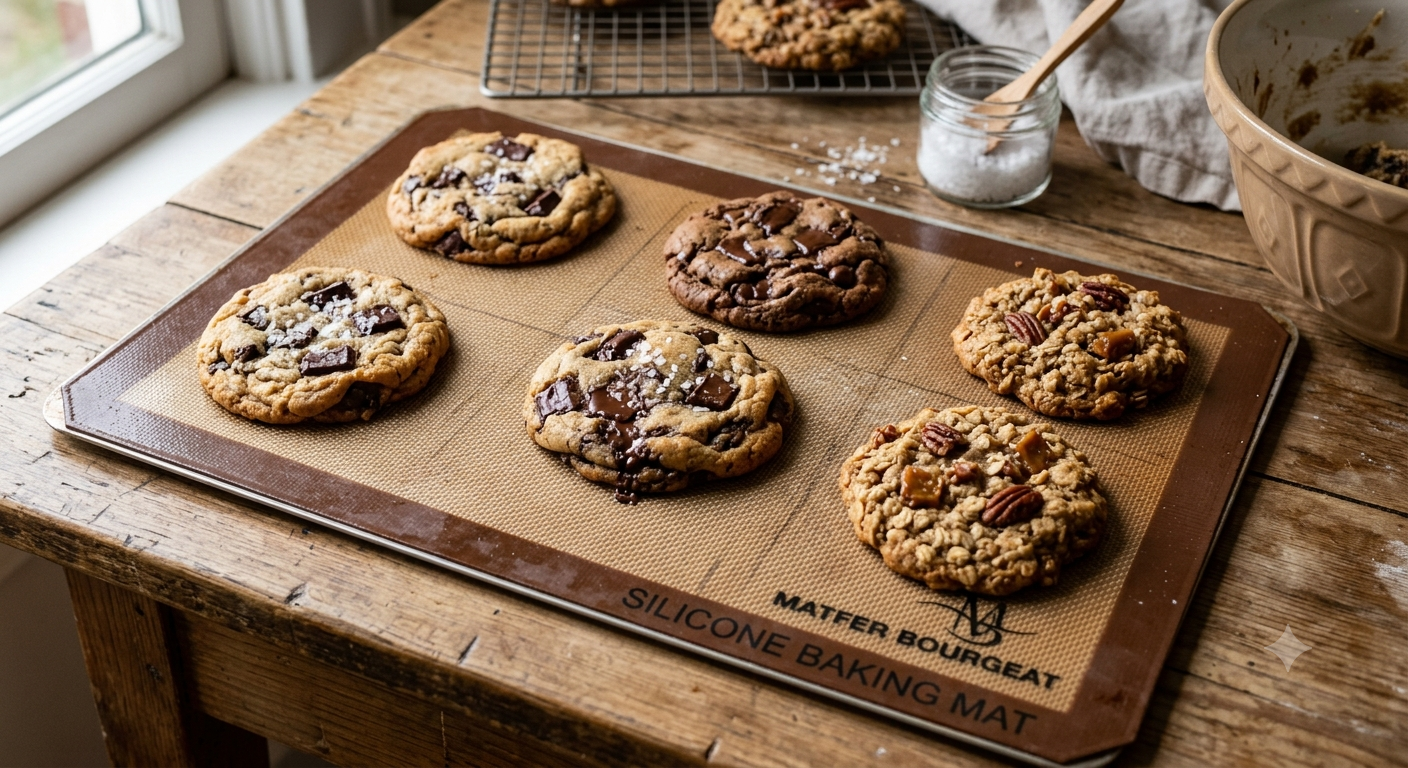
You’re baking cookies. This is where silicone mats truly shine. The mat provides a thin layer of insulation between the dough and the hot pan, which reduces bottom browning and produces more evenly baked cookies. If you’ve been dealing with cookies that burn on the bottom, a silicone mat on a light aluminum pan is the combination that fixes it.
You’re roasting vegetables regularly. The nonstick surface means roasted vegetables slide right off without sticking or leaving burnt residue on your pan. Over months of regular roasting, the mat saves significant cleanup time.
You bake frequently and want to save money. If you bake twice a week, you’ll go through a roll of parchment in about a month — roughly $60 per year. One silicone mat costs $10–30 and lasts years. The math is clear.
You want the most consistent results. The silicone layer standardizes the heat your cookies receive from the pan below. Batch after batch comes out the same. Parchment can vary slightly depending on the brand, thickness, and how flat it sits on the pan.
You’re environmentally conscious. Reusable beats disposable for obvious reasons. If reducing kitchen waste matters to you, the mat wins.
The Best of Both Worlds: My Actual Setup
Here’s what I keep in my kitchen and when I use each:
One Silpat silicone mat — lives on my Nordic Ware half sheet pan. Used for 90% of my cookie baking and vegetable roasting. It hasn’t needed replacing in years.
One roll of parchment paper — used for lining cake pans, wrapping bread dough, covering messy roasting jobs, and anything involving acidic or strongly flavored ingredients.
That’s it. Two products that together cover every baking scenario I’ve encountered. Total ongoing cost: about $5 every couple of months for a new parchment roll. The silicone mat was a one-time purchase.
The Best Parchment Paper
You don’t need to overthink this one. Any unbleached parchment paper from a major brand works well. Look for:
- Unbleached — slightly more natural, same performance
- Pre-cut sheets if you mostly use half sheet pans — saves time trimming
- Rolls if you need flexibility to line different pan shapes
The Best Silicone Baking Mats
We compared five top silicone mats in our dedicated best silicone baking mats guide. Here’s the quick summary:
Budget: AmazonBasics 2-Pack (~$10) — solid performance at the lowest price.
Mid-Range: OXO Good Grips (~$20-24) — dishwasher safe with OXO’s guarantee.
👉 Check current price: OXO Good Grips Baking Mat on Amazon →
Premium: Silpat (~$30-35) — the professional standard since 1965.
Common Questions
Can I use both at the same time? No need. Either parchment or a silicone mat — not both on the same pan. They serve the same purpose (nonstick barrier) and stacking them doesn’t add any benefit.
Can I substitute one for the other in any recipe? For most recipes, yes. The one exception is recipes that specifically require you to line a non-flat pan (cake pans, loaf pans) — you need parchment for those since silicone mats only work on flat surfaces.
Does parchment paper affect cookie texture differently than a silicone mat? Slightly. Cookies baked on parchment tend to have slightly crispier bottoms because parchment provides less heat insulation than silicone. Cookies on a silicone mat tend to have softer, more evenly browned bottoms. Neither is better — it depends on whether you prefer crispy or soft.
Is wax paper the same as parchment paper? No. Wax paper is coated in wax, not silicone, and it is NOT oven safe. It will smoke and potentially catch fire in the oven. Never substitute wax paper for parchment in baking. This is a dangerous mistake that’s more common than you’d think.
How do I clean a silicone mat? Warm soapy water and a soft sponge. Some brands are dishwasher safe — check the product listing. Never use abrasive scrubbers, knives, or steel wool. For stubborn residue, soak in warm water for 10 minutes before washing.
The Bottom Line: Parchment Paper vs Silicone Baking Mat
The parchment paper vs silicone baking mat debate doesn’t have a single winner — the answer is “both, for different jobs.”
If you’re buying one first: start with parchment paper. It’s cheaper, more versatile, and works with every pan you own. A $5 roll gets you started immediately.
When you’re ready to upgrade: add a silicone mat. It makes cookies better, saves money over time, and reduces waste. Even the budget AmazonBasics mat is a meaningful improvement.
The ideal setup — one silicone mat plus a roll of parchment — costs under $35 total and covers every baking scenario you’ll face.
For more on building your baking setup, check out our baking essentials checklist or our complete Essential Baking Tools for Beginners guide.
Happy baking, Clara Belle
Last updated: [DATE]. Prices fluctuate — always check current Amazon pricing before buying.