Why Your Cookies Burn on the Bottom (And How to Fix It for Good)
Quick Answer: If you’re wondering why cookies burn on the bottom while staying pale on top, the answer is almost never your recipe or your timing., the problem is almost never your recipe or your timing. It’s one of three things: your oven runs hotter than it says, your baking pan is the wrong material, or your rack position is too low. All three are fixable for under $30 — and once you fix them, burnt bottoms disappear permanently.
This post contains affiliate links. If you buy through them, I may earn a small commission at no extra cost to you — it’s what keeps this site running and lets me keep testing gear so you don’t have to.
You’re Not a Bad Baker — Your Kitchen Is Working Against You
Understanding why cookies burn on the bottom starts with accepting that it’s almost never a skill problem. If your cookies consistently burn on the bottom while the tops look underdone or barely golden, that’s not a technique issue — it’s a tool issue. Something in your kitchen is delivering too much heat to the underside of your cookies, and no amount of watching the oven or adjusting your timer will fix it.
I spent months thinking I was doing something wrong. Adjusting recipes, setting timers for two minutes less, hovering over the oven door. Nothing worked. The bottoms still burned. Then I changed three things — an oven thermometer, a new baking sheet, and my rack position — and the problem vanished overnight.
Here are the five most common reasons cookies burn on the bottom, ranked by how likely they are to be your problem, and exactly what to do about each one.
Reason #1: Your Oven Is Lying to You
This is the most common cause and the one nobody suspects first.
When you set your oven to 350°F, the actual temperature inside could be anywhere from 300°F to 400°F. Home ovens are notoriously inaccurate — most run 25 to 50 degrees off their set temperature, and some are even worse. If your oven runs hot, the bottom heating element is blasting your cookies with more heat than the recipe intended.
The worst part? You’d never know without checking. The number on the dial means almost nothing.
The fix: Buy an oven thermometer.
Hang one from your oven rack, preheat, and see what the actual temperature is. If your oven runs 30 degrees hot, just set it 30 degrees lower than the recipe says. Problem solved — permanently.
The best part is this fix costs less than a coffee.
👉 Check current price: Rubbermaid Commercial Oven Thermometer on Amazon →
👉 Check current price: Taylor Large Dial Oven Thermometer on Amazon →
Want a deeper comparison of oven thermometers? Check out our full guide: 10 Essential Baking Tools Every Beginner Needs →
Reason #2: Your Baking Pan Is the Wrong Color
This is the fix that shocks people the most — and the one that makes the biggest visible difference.
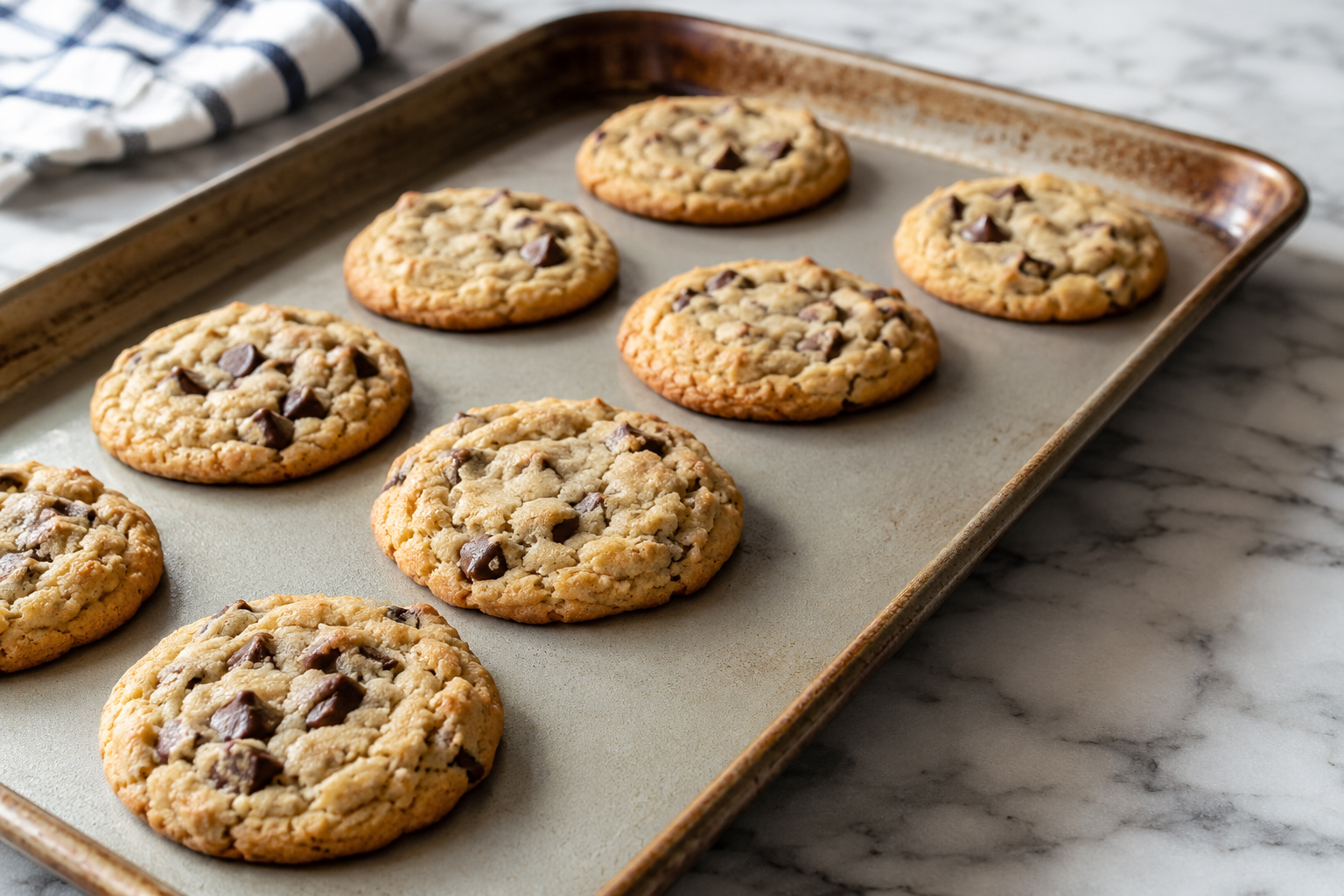
Dark-colored baking pans absorb more heat than light-colored ones. That’s basic physics, and it directly affects your cookies. A dark nonstick pan pulls in heat and concentrates it on the bottom of whatever is sitting on it. The result: the undersides of your cookies brown (and then burn) much faster than the tops.
Light-colored aluminum pans reflect heat instead of absorbing it. They distribute warmth more evenly, which means the top and bottom of your cookies bake at closer to the same rate.
If you own dark nonstick baking sheets and your cookies always burn on the bottom, this is almost certainly a major contributor. Switching to light aluminum pans is one of the most dramatic upgrades a home baker can make.
The fix: Switch to light-colored aluminum sheet pans.
👉 Check current price: Umite Chef Natural Aluminum Half Sheet Pan on Amazon →
👉 Check current price: Nordic Ware Naturals Half Sheet on Amazon →
Reason #3: Your Rack Is Too Low
Oven heat comes from two places — the heating element on the bottom and the one on the top. When your baking sheet sits on the lowest rack, it’s physically closer to the bottom heating element, which means more direct heat hitting the underside of your cookies.
This one is a free fix.
The fix: Move your baking sheet to the center rack.
The middle position gives you the most even heat distribution from both elements. If you’ve been baking on the bottom rack (or worse, directly on the oven floor), this single change can eliminate burning without spending a cent.
For extra insurance, try the double-pan method: stack two sheet pans together and bake your cookies on the top one. The air gap between the two pans acts as insulation and dramatically reduces bottom heat. This is an old bakery trick that works every time.
Reason #4: You’re Not Using a Liner
Baking cookies directly on a bare metal pan — even a light-colored one — means the dough sits in direct contact with the hot metal surface. A silicone baking mat or parchment paper creates a thin barrier between your dough and the pan, which softens the heat transfer just enough to prevent scorching.
This is especially important for thin cookies, sugar cookies, and anything with a high butter content that spreads flat against the pan.
The fix: Use parchment paper or a silicone baking mat.
Parchment is cheap and disposable. Silicone mats are reusable and pay for themselves within a few months.
👉 Check current price: AmazonBasics Silicone Baking Mat on Amazon →
👉 Check current price: OXO Good Grips Silicone Baking Mat on Amazon →
👉 Check current price: Silpat Premium Baking Mat on Amazon →
Reason #5: Your Butter Was Too Warm
This is the one baking variable that actually is a technique issue — but it’s still easy to fix.
When butter is too soft or partially melted before you mix your dough, the cookies spread thinner and faster in the oven. Thinner cookies have less mass to absorb heat, which means the bottoms cook and burn faster while the center is still trying to set.
Room temperature butter should be cool to the touch and hold its shape when you press it — it shouldn’t be squishy, shiny, or starting to slump. If you can poke it and your finger leaves a clean indent without the butter collapsing, it’s ready.
The fix:
- Take butter out of the fridge 30 to 45 minutes before baking — no more
- If you’re in a rush, cut the butter into small cubes to speed up softening without overshooting
- Never microwave butter to soften it — the edges melt while the center stays cold, giving you uneven texture
- If your dough already feels too soft, chill it in the fridge for 15 to 20 minutes before scooping and baking
The Quick-Fix Checklist
Now that you know why cookies burn on the bottom, here’s how to fix it — work through this list in order:
- Check your oven temperature with a thermometer — adjust the dial if it runs hot
- Look at your baking sheet — if it’s dark, switch to light aluminum
- Move to the center rack — never bake cookies on the bottom rack
- Add a liner — parchment or silicone mat between dough and pan
- Check your butter — cool to the touch, not soft or melted
Most people only need to fix one or two of these to eliminate burnt bottoms permanently. If you fix all five and your cookies are still burning, your oven may need professional recalibration — but that’s rare.
The Tools That Fix Burnt Cookies
Here’s a summary of everything mentioned in this post. These are the same tools I recommend in our complete Essential Baking Tools for Beginners guide.
| Problem | Fix | Approx. Cost |
|---|---|---|
| Oven runs hot | Oven thermometer | ~$8–15 |
| Dark pans | Light aluminum sheet pan | ~$15–35 |
| No liner | Silicone baking mat or parchment | ~$10–30 |
Total to fix everything: under $60. That’s less than the cost of ingredients you’d waste on a few more batches of burnt cookies.
The Bottom Line
Burnt cookie bottoms are one of the most frustrating and most fixable problems in home baking. Once you understand why cookies burn on the bottom, the fix is surprisingly simple and affordable. The solution is almost never “watch them more carefully” or “take them out sooner.” It’s fixing the equipment and setup issues that are delivering too much heat to the wrong place.
An oven thermometer, a light-colored pan, and a silicone baking mat. That’s the trifecta that turns burnt bottoms into perfectly golden undersides — every single time.
If this guide helped you, check out our full breakdown of 10 Essential Baking Tools Every Beginner Needs for more tools that make baking reliable instead of stressful.
Happy baking, Clara Belle
Last updated: [DATE]. Prices fluctuate — always check current Amazon pricing before buying.